
For those exploring care options for the end-of-life journey, making the decision to choose hospice care can feel overwhelming and filled with uncertainty. One of the first questions that often comes to mind is “can I change my mind about hospice?”
There are many reasons someone might opt for hospice care and then later change their mind. The good news is that stopping or even restarting hospice care, so long as you remain eligible, is absolutely an option even after you begin care. Let’s take a closer look at scenarios that could change your decision and what to do if you decide hospice care is no longer right for you.

Choosing Hospice: Eligibility, Recertification and Patient Choice
Hospice care is specialized support that focuses on comfort, dignity, and quality of life for people facing a life‑limiting illness. If you’re exploring whether hospice is right decision, there are some common signs it could be time to choose hospice care:
- Treatment for a condition is no longer working, or aggressive intervention is no longer wanted.
- Your doctor has told you that life expectancy is likely six months or less.
- A person’s health is worsening.
- Eating and drinking have become challenging.
- There have been noticeable behavior changes, such as increased confusion or trouble communicating.
- The person is sleeping more than usual, sometimes for most of a 24-hour period.
- Self-care is becoming increasingly difficult.
- Caretakers and loved ones are feeling overwhelmed.
It’s important to know that some of these signs appear very late in the end-of-life process. If you’re uncertain whether hospice care is the best option, our hospice team can help walk you through the decision.
There are three important things to understand about what happens after you make the hospice decision:
1. Hospice Eligibility
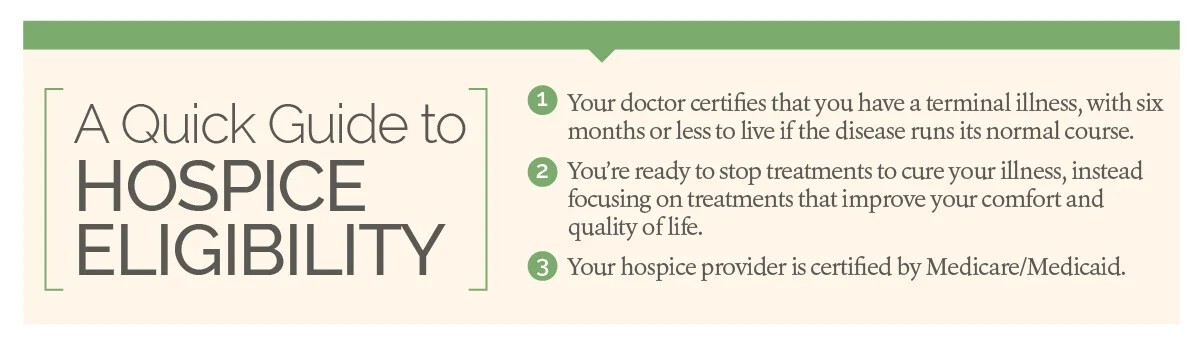
In order for a person to receive the Medicare hospice benefit:
- A physician must certify a life expectancy of six months or less if the illness follows its usual course
- The patient must choose treatment focused on comfort, symptom relief and quality of life, rather than curative care
- The hospice provider must be Medicare certified
2. Hospice Recertification
Once hospice care is underway, the plan of care will be reviewed periodically (with input from the patient and family) to ensure that care remains appropriate and aligned with person’s condition. As part of this, hospice recertification is a process that allows a patient to continue receiving hospice services when their illness still meets eligibility criteria beyond the initial benefit period. 1
This means that in many cases, hospice care can continue beyond the initial six months, as it did for former President Jimmy Carter, who received hospice care for nearly two years before he passed away in 2024.
3. Patient Choice and Hospice
Along with eligibility and recertification, patient choice is part of receiving hospice care. This includes the right to refuse care at any time, for any reason, even if you agreed to hospice care at first but now have decided you want to stop the care. 2
Reasons Someone Might Reconsider Hospice Care
Many patients reconsider their decision about hospice because their medical, personal or emotional needs shift over time. A change in symptoms, a new treatment option, or even a period of unexpected improvement can make someone feel more hopeful or more motivated to pursue curative care again.
Others may struggle with the emotional weight of choosing comfort‑focused care, especially if they worry about how their decision affects their identity, independence, or sense of control. Personal circumstances—like a change in living situation, caregiver availability, or spiritual beliefs—can also influence whether hospice still feels like the right fit.
Real‑world scenarios help illustrate how fluid these decisions can be. A patient with heart failure might stabilize unexpectedly after medication adjustments and feel ready to resume disease‑directed treatments. Someone with cancer may learn about a newly available therapy and want to explore it, even if the chances of success are small.
Family dynamics can also play a major role: a patient may leave hospice because a loved one is urging them to “keep fighting,” or return to hospice after realizing that aggressive treatments are causing more stress than benefit.
These situations highlight that choosing—or changing—hospice care is deeply personal, and it often evolves as a patient’s condition, goals and support system change.
The Process: Steps to Discontinue or Resume Hospice Services
Patients who decide to withdraw from hospice care follow a straightforward process that centers on communication, documentation, and coordination with their care team. Medicare outlines that a patient may revoke hospice at any time by signing a revocation statement and notifying the hospice provider, after which Medicare coverage returns to standard Part A and B benefits. 3
If the patient later wishes to reenroll, they can do so as long as they continue to meet hospice eligibility criteria; reenrollment simply begins a new benefit period.
A clear plan helps patients and families navigate the transition smoothly. Withdrawing from hospice typically involves informing the hospice team, discussing next steps with a primary care physician or specialist, and confirming how medications, equipment and services will change once hospice ends.
Reenrollment later requires a physician’s certification of eligibility and completion of hospice election forms. The process is designed to be flexible so patients can shift between comfort‑focused and curative care as their goals evolve.
Ready to Learn More?
Choosing to begin or discontinue hospice services are a very personal decision. At Amedisys, our hospice specialists understand that having expert guidance throughout the hospice journey can support difficult decisions and conversations with loved ones. Reach out today to the care center nearest to you—we’re standing by to help.
Deb Gallaher, MBA, MSN, RN, NE-BC, CHPN, is a Senior Hospice Clinical Education Specialist for Amedisys. She has 10 years of experience in hospice and is passionate about sharing her insights on high-quality care.