
People often think home health care and home care are the same thing. Many agencies use the terms interchangeably, depending on the state you’re in. The terms sound similar, and both types of care are delivered in the home. But there are important differences between home care and home health care. Knowing the differences can help you decide which type of care is right for your needs and budget.
When comparing home health care vs. home care, it’s useful to know the definitions of each as a starting point.
Home Health Care Definition
The home health care definition is medical services provided at home to treat a chronic health condition or help you recover from illness, injury or surgery. Some people start home health care after a health decline or getting diagnosed with a serious medical condition. Many people transition to home health care after a stay in a hospital, rehab center or skilled nursing facility. The primary goals are to help people recover and stay as independent as possible.
Here are some important facts about the home health definition:
1. Home health care services address intermittent or periodic needs. 1 It may include:
- Skilled nursing care, including wound care and administering intravenous (IV) medications
- Physical therapy
- Speech therapy
- Occupational therapy
- Medical social work
- Patient and caregiver education
- Help with daily tasks like bathing and dressing from a home health aide, as part of the home health plan of care (not as a standalone service)
2. Not everyone is eligible for home health care services. Home health eligibility criteria include: 2
- Being considered homebound.
- Needing intermittent or short-term care
- Needing care that requires the services of skilled professionals.
- Having your plan of care ordered and supervised by a doctor or other authorized provider.
3. When ordered by a doctor, Medicare, Medicaid and some private insurance plans cover the cost of home health care services for eligible patients. 3

Definition of Home Care
The definition of home care is help with daily activities to allow people to stay safe at home. It is often used by individuals with chronic illness, those with disabilities and people recovering from surgery. Home care is also sometimes called personal care, companion care, custodial care or homemaker services.
Here are some important facts about the home care definition: 4
- Home care services may include:
- Bathing, toileting, dressing and grooming
- House cleaning and other chores
- Transportation
- Meal preparation
- Companionship
- Medication reminders
- Home care services do not include:
- Medical assessment and education
- Medication administration by licensed medical staff
- Nursing services
- Physical, occupational or speech therapy
- Wound care and dressing changes
- Injections or IV therapy
- Foley catheter and ostomy care
Many patients pay for home care out of pocket. In some cases, Medicaid or long-term insurance will cover the costs of home care.
Similarities Between Home Care and Home Health Care
To understand the difference between home care and home health care, it helps to know the similarities. Both offer:
- Care in the comfort and safety of your home
- Help for people to feel better and stay as independent as possible
- Assistance with daily tasks like bathing, dressing and grooming (only as part of the skilled plan of care in home health care)
- Less expensive care than hospital or facility care
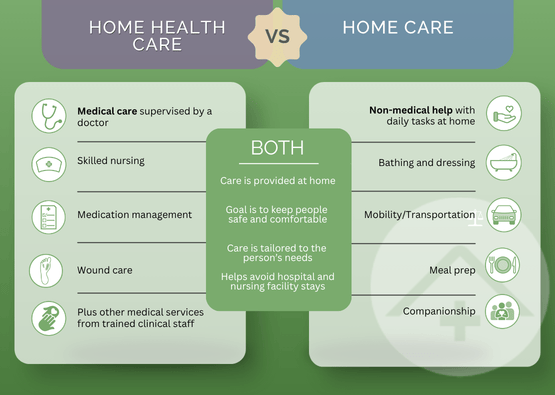
Differences Between Home Care and Home Health Care
Some of the key differences between home health vs. home care are:
Type of Care
- Home health care provides “clinical” or “skilled” care by licensed nurses and therapists.
- Home care provides “non-clinical” or “non-skilled” care by professional caregivers.
Services
- Home health care services are more medical in nature. Home health aides are available to help with things like bathing, grooming and dressing until you are safely able to do them again or have a caregiver who can safely assist you. But the focus of care is skilled nursing and therapy.
- Home care helps with everyday tasks like bathing, dressing, grooming, cooking, cleaning and transportation. It does not include medical care like nursing or therapy.
Eligibility
- Home health care requires a doctor’s order. Patients have to meet certain eligibility criteria. 5 For example, they must have limited ability to leave their home and require assistance to do so.
- Since people usually pay for home care out of pocket, there are no eligibility requirements.
Length of Care
- Home health care continues as long as your doctor certifies, and you continue to meet eligibility requirements.
- Home health care is generally goal-oriented, episodic and ends when goals are met or services are no longer medically necessary.
- Home care continues as long as you want, based on your budget and needs.
Payment
- Home health care is covered, either all or in part, by Medicare, Medicaid and most private insurance plans for eligible patients. Patients may have additional financial responsibility depending on coverage.
- Home care is typically paid directly by the patient or long-term care insurance. Medicaid may also cover home care.
Care Team
- The home health team is made up of skilled professionals such as nurses and therapists.
- Family members and professional caregivers provide home care services.
Frequency
- Home health care visits are typically a few times per week, depending on the patient’s needs and doctor’s orders.
- Home care can help patients 24/7, depending on the patient’s budget and needs.
Location
- Patients can receive home health care in their place of residence, including assisted living facilities and group homes, as long as it is a residence that does not provide medical care.
- Home care is typically provided at home, although it can be provided in other locations if the person is able and willing to pay for it.
Although there are many differences between home care and home health care, both types of care can help people stay safe and independent in their homes. If you need medical treatment at home, home health care may be appropriate. If you need help with daily activities, home care may be the better fit. To learn more about your eligibility and whether home health care is appropriate for your needs, call a care center near you.
TeRonna Hall, BSN, RN, CCP, serves as a Clinical Content Development Specialist at Amedisys. With 36 years of healthcare experience, including 34 years in home health, she is dedicated to educating others on health-related topics.
Melanie Morris, MBA, MSN, RN, COS-C is the Assistant Vice President of Care Delivery Management for Amedisys. In her 28 years as a nurse, she has enjoyed caring for many types of patients and is passionate about providing holistic care to patients in their homes, especially those with chronic conditions such as wounds.